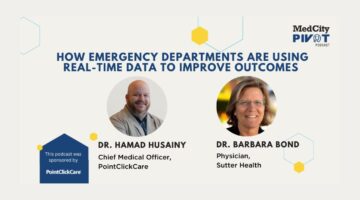
MedCity News Pivot Podcast: How Emergency Departments Are Using Real-Time Data to Improve Outcomes
How can AI benefit and improve patient outcome in the emergency department? Watch the latest episode to find out.
Alan Murray on improving access for medical transportation.
Celebrating teamwork is essential for acknowledging its profound impact on healthcare excellence. It is a powerful catalyst that fosters patient-centered care, optimizes resource utilization, nurtures professional growth, and strengthens the healthcare system.
Ransomware attacks had an impact beyond mortality rates as well, with 71% of respondents saying that these cyberattacks drove up lengths of stay and 36% saying they led to an increase in clinical complications.
Weill Cornell Medicine has launched a campaign with the goal of raising $1.5 billion that will be used to invest in research initiatives, including a precision medicine enterprise, and to fund a scholarship program that helps students who qualify to graduate debt-free. So far, the health system has raised $750 million.
Two UnitedHealthcare policies have raised several concerns among providers, including that they may display anti-competitive behavior and could block patient access to certain healthcare services. The American Hospital Association is asking the FTC and CMS to review and potentially block these policies.
Patients and caregivers want to feel prepared to look after themselves or loved ones when they leave the hospital, but hospitals often fail to fulfill these expectations.
In a landscape where complexity has long been the norm, the power of one lies not just in unification, but in intelligence and automation.
According to a survey of more than 600 nurses conducted by LinkedIn last month, 25 percent of respondents said artificial intelligence will have the greatest negative impact on nursing, and only five percent believe it will have the greatest positive impact on the field.
According to a survey from Zebra Technologies, an expected 97 percent of bedside nurses and 98 percent of physicians will use mobile devices in the healthcare setting by 2022.
UPMC seeks to give patients on-demand, high-quality care through UPMC AnywhereCare.
The financial burden of patient harm at the hands of hospitals is likely more than $100 billion annually, but if those same hospitals had access to reliable, real-time data it would go a long way in curbing both harm and costs, according to a new survey. Pascal Metrics, a Washington, D.C.-based patient safety organization, recently […]
There is some good news for patients when it comes to the changes underway as part of the Affordable Care Act (ACA). The reforms and transitions have started a national discussion about how to deliver care in a different way – and we are headed to a system built more on collaborative, patient-centered team care. […]